Behar-Bechukotai: The Holiness Hidden in Trust | Parsha Map · Ep 01
May 08, 2026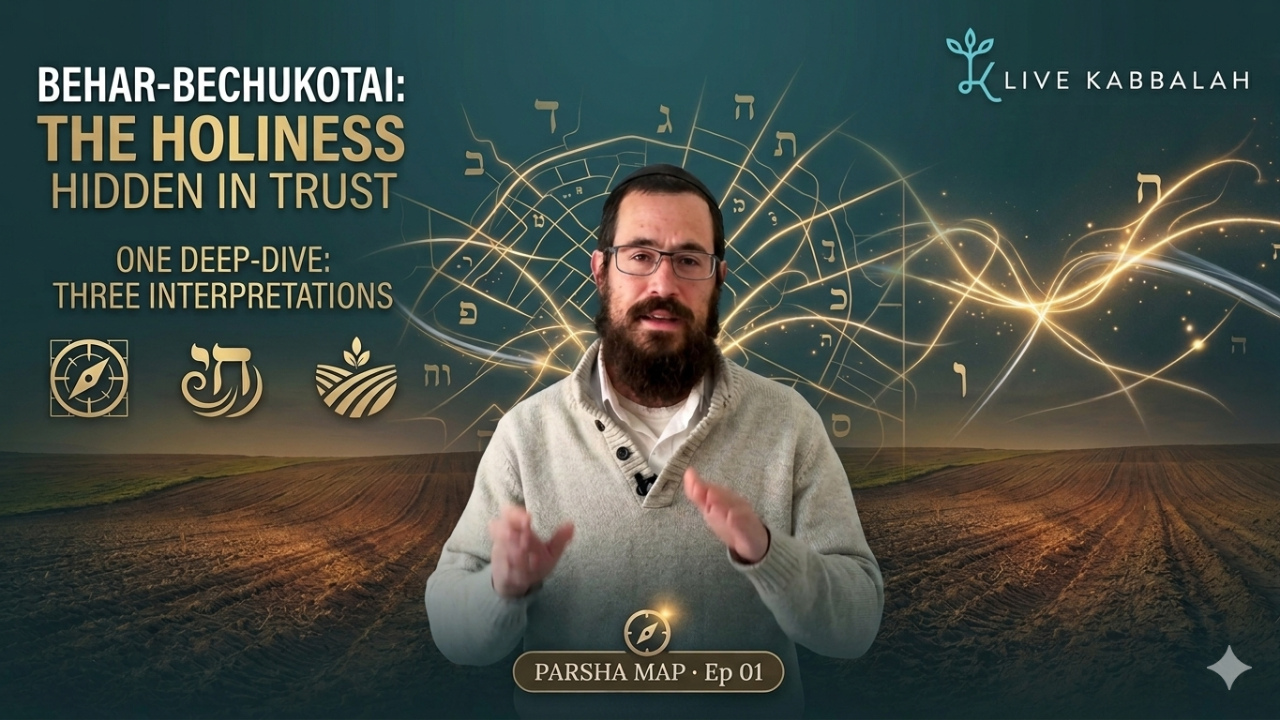
B"H
Behar-Bechukotai: The Holiness Hidden in Trust
Greetings, dear friends!
This week, we live with Parshat Behar-Bechukotai, and the theme that runs through both is bitachon, trust. Probably the hardest trait for a human to attain.
Behar opens with Shmita and Yovel, the sabbatical and jubilee years. After six years of working in the field, we stop.
In the seventh year, we let the field rest. After seven cycles of Shmita, the forty-ninth year, we arrive at the fiftieth, the Yovel, where everything returns to its default state. A master Shmita. Seven times seven.
This is the same logic as Shabbat. Six days we work. The seventh, we let go. We stop pretending to be in control. We give it back to Hashem. That, on the deepest level, is what Shabbat means. To let go.
Shmita is the same thing on a longer scale. Yes, I plowed the field. Yes, I sowed and reaped. Yes, I did the work. But at the end, the abilities of the land, the abilities of what we call nature, the abilities I myself have, all of it is in the hands of the Creator.
So if we had to name the theme of Behar in one word, it would be bitachon.
Rabbeinu Bechaye writes a whole section in his book called Sha'ar Bitachon, the Gate of Trust. He describes the advantage a person has in life when they actually carry this measure of trust in the Creator. The equanimity. The steadiness. The healthy state of mind. Their nervous system is not running on dysregulation, because they are not carrying the weight that everything depends on them. They are living the truth that the Creator is with them in this.
Now what does bitachon actually mean? The Mitteler Rebbe teaches something striking. Bitachon comes from the word tiach. Cement.
Think about a building. Cement is what holds it. Not the decorations. Not the paint. The cement is the inner structure. Without cement, the building does not stand.
Bitachon is the cement of the soul. Not a feeling that comes and goes. Not a thought we hold in the mind. Cement. Through and through. Inside the very structure of who we are.
There is a beautiful question raised by the Bat Ayin, Rabbi Avraham Dov of Avritch, the chief rabbi of Tzfat at the time of the great earthquake here in 1836. He asks: the Parsha opens, "Ki tavo el ha'aretz, when you come into the land, ve'shavtah ha'aretz Shabbat la'Hashem, the land will rest." First the rest. Then the Torah says, "six years you shall work."
But that is not the order we live. We work first, then we rest. Why does the Torah reverse it?
The Bat Ayin answers: real life on the land, real entry into a higher state of being, is contingent on bitachon. Trust comes first. The Torah is telling us that the moment you arrive, you are already in Shmita. Already in surrender. Already in the awareness that this is not yours alone. The trust is the foundation. The work that follows is built on top of it.
Golda Meir said it in her own way. To believe in miracles in the land of Israel, you have to be a realist. Belief and trust are not opposites of seeing the world clearly. They are how we see clearly.
Then comes the next layer, and this one is for me one of the quiet jewels of the parsha. The Bat Ayin notices something inside the word betach itself. The three letters are bet, tet, chet. When you spell each letter out fully, each one contains the inner letters yud and tav.
Yud and tav together equal 410. The same gematria as kadosh. Holy.
So inside the very word for trust, hidden three times, is the value of kadosh. Kadosh. Kadosh. The same triple kadosh we say in the Kedusha. The same triple kadosh that proclaims G-d is holy above, below, and within.
Kadosh b'kirbecha. G-d is holy within us. What does that mean, holy within us? It means bitach. It means trust. When we live in bitachon, we discover that holiness is not only above. The within becomes possible. The trust is the doorway.
Three letters. Three kadoshes hidden inside them. The whole secret of where holiness lives, sitting quietly inside one Hebrew word.
Then the Torah does something rare. It predicts what we will ask. After all the rules of Shmita and Yovel, there could be many years where we are not working the land, not earning income. And the Torah anticipates the question. "What will we eat in the seventh year? We did not plant. We did not harvest. What will we do?"
This is the most human question there is. The deepest anxiety a person carries is exactly this. How am I going to survive? How am I going to pay the bills? How am I going to feed my children?
What strikes me is how the Torah holds the question. It does not shame us for asking. It does not call us weak for feeling anxious. It says, you may ask. You are not weird for feeling nervous. You are not strange for having anxiety about money, about the future, about what is coming. This is just how we are made.
That alone gives a kind of relief. Our nervous system is not broken because it gets activated around survival. That is the system doing its job.
But then the Torah answers. "I will command my blessing upon you." On the sixth year, there will be so much that it will spill over into the seventh, and even into the years beyond.
There is going to be. There is going to be.
And here Reb Zusha of Hanipoli, brought down by his brother Rabbi Elimelech of Lizhensk in the Noam Elimelech, opens this verse in a way that has stayed with me.
Reb Zusha says: when we ask "what will we eat" from a place of contracted fear, when we say "that is it, I am doomed, it is not going to happen," we are closing the channel. The channel of blessing has been open the whole time. But our anxiety, our certainty that we are alone, has shut it down.
So G-d says, "I will command my blessing." And the word command, Reb Zusha teaches, means I have to open a new channel. You closed yours. So I will open another.
There is something almost tender in this image. As if G-d is saying, "I have to reach this person. They are convinced they are a failure. They are sure nothing will work out. They are hiding under the covers, frozen, scared. Let me find a way in. Knock knock. Peekaboo. I am here. Just look at me. You have this."
The blessing was always there. The channel was always there. We are the ones who close it. And even when we close it, G-d will open a new one. That is how relentless the love is.
Then we move into Bechukotai. "Im bechukotai telechu, if you will go in my chukim, I will give your rains in their proper time."
What is a chok? We have three categories of mitzvot. Mishpatim are laws we understand intuitively, like do not steal. Edut are laws that bear witness to historical events, like Pesach and Shabbat. Chukim are different. Chukim are laws without rational explanation. They go past the intellect.
Why does the Torah connect chukim to rain, to gashmiyut, to all the material flow of life?
The Alter Rebbe teaches that chukim comes from chakikah, which means engraved. There are two ways to write. You can write on a scroll, ink on parchment, where the letters sit on top. Or you can engrave, like the Ten Commandments, where the letters are carved through the stone, part and parcel of the stone itself.
Im bechukotai telechu means: do not just hold this as concept. Do not let your trust, your awareness of G-d, sit on top of you like ink on parchment. Engrave it. Through and through. Let it become the very material of who you are.
When you do that, the geshem, the rain, the material life that we receive, is no longer something separate, something we are chasing. It becomes the natural result of an inner state that is already aligned. The flow above and the flow below are the same flow.
This is what the parsha is asking. Not for us to grasp these ideas. To engrave them. To let bitachon become cement. To let trust become the inner structure that holds us through any weather.
Behar gives us the principle. Bechukotai tells us how deep it has to go.
The practice for this Shabbat and the week ahead is gentle. Notice when the channel is closing. Notice when "what will we eat" starts to spiral into "that is it, I am doomed." That is the moment to remember. The channel is still there. The blessing is still flowing. And the very letters of betach hold three kadoshes inside them, waiting to be felt as the holiness within.
May the trust become cemented. May it engrave itself in us. And may we walk into Shabbat with the channel wide open.
Many blessings 🙏
Rabbi Amichai
If you would like to go deeper into your own soul map, your natal chart, your parsha of birth, your Hebrew name, and the spiritual blueprint underneath your life, I invite you to explore Soul Mapping. Learn more at livekabbalah.com/soul-mapping.