18th of Elul - Higher and Lower Unity
Aug 31, 2026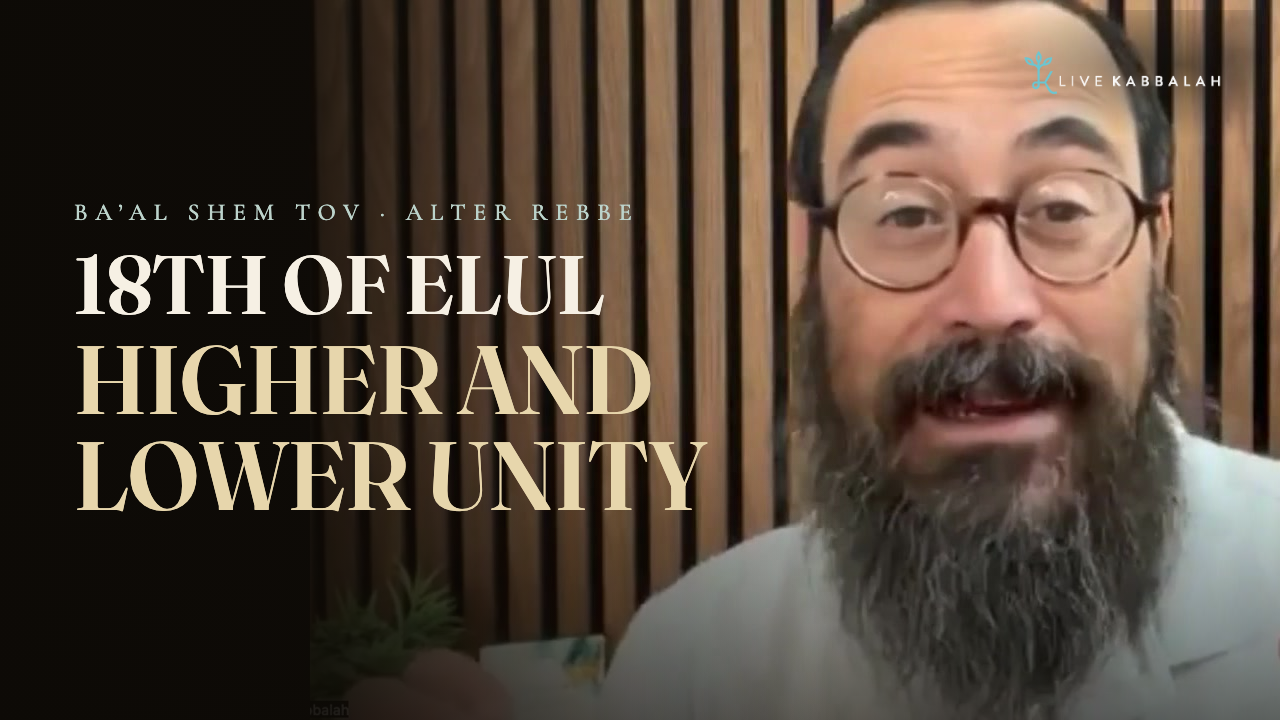
The Letter Ayin: Higher Unity, Lower Unity, and the Shema
The Shema does not only tell us that G-d is One.
It asks us to become witnesses to that oneness and to know this truth internally.
In our first class on the Hebrew letter Ayin, we explored the 70 gates of seeing. We looked at ayin tovah, the good eye, and the way many perspectives can return to one Source.
This second Ayin teaching takes us deeper.
What does it mean to say that G-d is One while we live inside a world filled with difference, conflict, responsibility, and choice?
How can the many be real enough to require our service, yet never become separate from the One?
Chai Elul and the awakening before Rosh Hashanah
The class was taught on Chai Elul, the 18th day of Elul, the birthday of both the Baal Shem Tov and the Alter Rebbe.
Chai means life.
Chai Elul brings life into the inner work of Elul as we approach Rosh Hashanah.
Rosh Hashanah is not only the beginning of a calendar year. It is the day on which creation is renewed at its root. We stand before Avinu Malkeinu, our Father and our King, and awaken the will to crown Hashem again.
The shofar gives voice to something deeper than language. It is the cry of the child who has forgotten where they came from, suddenly recognizing the face of their father.
The Baal Shem Tov gives the story of a prince who left the palace and eventually forgot that he was a prince. When the king's carriage passed, something ancient awakened inside him. He ran toward the king and cried out, \“Father.\”
That cry was enough.
Rosh Hashanah brings us face to face with the Source we may have forgotten.
Before we speak about unity as an idea, we have to feel the longing to come home to it.
Garments of skin and garments of light
The letter Ayin opens a beautiful wordplay around the Hebrew word or.
Written with an Ayin, or means skin.
Written with an Aleph, ohr means light.
Our sages teach that Adam was first clothed in garments of light. After the descent of consciousness, those garments became garments of skin.
This does not mean that the body is bad.
The animal soul is not evil simply because it is animal. An animal follows its nature. Our body, instincts, emotions, and need for survival all belong to the life G-d has given us.
The work is not to destroy the garment.
The work is to bring light into it.
The Divine soul brings awareness of the Source. The animal soul brings energy, desire, and the power to act in the world. When the two are integrated, the body itself can become a garment for light.
This is the spiritual task entrusted to us. We bring ohr into or. We bring awareness into embodiment. We allow the Neshama to illuminate the life we are actually living.
The large Ayin and Dalet of the Shema
In a Torah scroll, the final Ayin of Shema and the final Dalet of Echad are written larger than the surrounding letters.
Together they spell ed, witness.
When we say, Shema Yisrael, Hashem Elokeinu, Hashem Echad, we are not only making a theological statement.
We are bearing witness.
To witness is to see deeply enough that what we see changes the way we live.
The same two letters can be reversed to spell da, know.
Sight becomes knowledge. Knowledge becomes consciousness. Consciousness becomes a life that affirms oneness.
The Shema calls every scattered part of us back into that awareness.
Higher unity
Chassidus speaks of yichuda ila'ah, higher unity.
From this perspective, nothing exists outside G-d.
Creation is not an independent reality standing beside its Creator. The world exists because Divine vitality brings it into being every moment.
If that vitality were withdrawn, creation would not simply become empty. It would cease to exist.
Higher unity asks us to loosen our certainty that the world is as separate as it appears.
Imagine rising in an airplane and seeing houses become tiny shapes and cars become moving points. Rise higher and the entire earth becomes one small planet within an immeasurable cosmos.
The perspective changes what seems central.
Higher unity takes us beyond even that image. It reminds us that all existence is held inside the living oneness of Hashem.
This is not meant to make our lives insignificant.
It frees us from the burden of believing that everything begins and ends with the small self.
Lower unity
Chassidus also speaks of yichuda tata'ah, lower unity.
From within ordinary consciousness, the world feels separate. We experience ourselves as individuals. We make choices. We face consequences. We are responsible for how we use our time, bodies, relationships, and resources.
Lower unity does not deny this experience.
It brings the awareness of G-d into it.
There is an Owner of the world. There is purpose. There is moral order. Our actions matter.
If higher unity says that nothing exists outside Hashem, lower unity says that everything that appears to exist has a role in serving Hashem.
The table at which we pray may not know the intention with which it is being used. The wood came from a tree. A carpenter formed it. A person now places a Siddur upon it.
The inanimate is lifted into a purpose it could not know by itself.
In the same way, our physical life can be lifted by intention.
Food becomes strength for a mitzvah.
Money becomes generosity.
Speech becomes encouragement and prayer.
The body becomes a vessel through which the soul can act.
Lower unity is not less sacred than higher unity. It is where unity becomes lived.
When the two unities meet
We need both perspectives.
If we speak only of higher unity, we may use spirituality to float above responsibility. We may say that everything is G-d while ignoring the work placed in front of us.
If we live only in lower unity, we may become trapped in separation. We may believe that the visible world is all there is and that every burden rests on us alone.
Higher unity remembers the Source.
Lower unity serves the Source within creation.
Higher unity gives us surrender.
Lower unity gives us responsibility.
Together they allow the many to return to the One without erasing the beauty of the many.
A practice with the Shema
Before saying the Shema, become still for a moment.
Notice the many parts of your life that are asking for your attention.
Your family.
Your work.
Your body.
Your fears.
Your hopes for the year ahead.
Do not push them away.
Gather them.
As you say Hashem Echad, remember that none of these parts exists outside the One.
Then ask:
- Where am I treating multiplicity as separation?
- What would it mean to bring higher unity into one practical area of my life?
- How can my body and animal soul become garments for greater light?
The work of Ayin is not merely to see oneness from a distance.
It is to witness it.
It is to know it.
And then it is to live in a way that allows every part of creation to remember where it comes from.
May the cry of the shofar awaken the child within us who still remembers the Father.
May the light of the Neshama enter the garments of our daily life.
And may the higher unity of Hashem become visible through the lower unity of how we choose, serve, and love.
Watch the class
Listen to the class
Rabbi Amichai Cohen