Avraham and Bitachon: When Faith Becomes Trust
Oct 27, 2026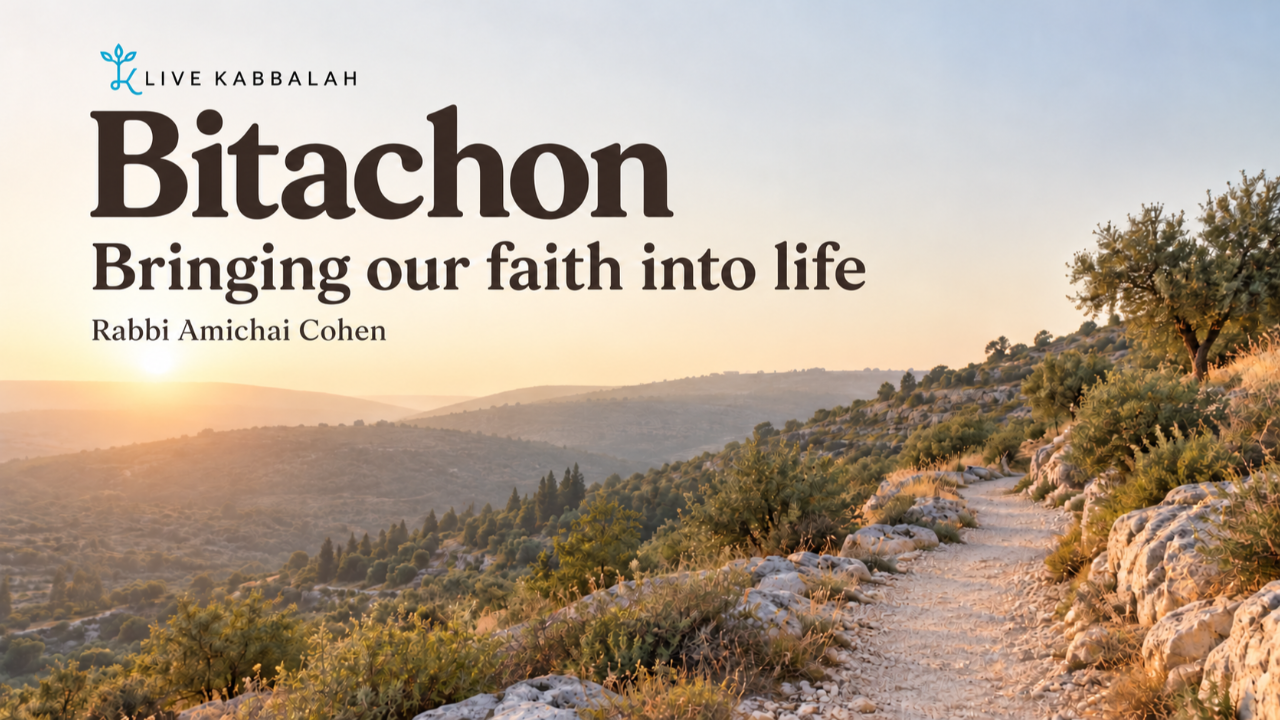
B"H
When we meet Avraham in the Torah, we meet a remarkable human being. The Rambam describes him as a genius of the highest order, a philosopher who understood the sciences and who searched for G-d with his whole being. And he was sent through ten tests, each one different from the one before.
What runs through all of them is one quality: trust. This week, as we read about Avraham, I want to share a short teaching on bitachon, and then go deeper into what it can mean for our own lives.
Listen to this teaching on Spotify
How can we give G-d charity?
The Torah says of Avraham: "And he believed in G-d, and He counted it for him as tzedakah" (Bereishit 15:6). What is the connection between belief and charity? And how could a human being give anything to G-d?
The answer is that there are two kinds of belief. There is a passive belief that simply carries us. And there is an active belief, where I choose to believe, and I bring that belief into the way I live. On a deeper level, active emunah becomes bitachon, trust.
Rav Saadia Gaon teaches that we cannot have emunah without bitachon, and we cannot have bitachon without emunah. Someone who believes but does not live that belief shows that the belief has not yet reached its depth. And someone who wants to build something in the world without the larger vision of faith cannot fully bring it into being. The two go hand in hand.
G-d created a world in which we could believe in Him passively: take the good, dodge the bad, make our plans, and see them work out some of the time. When we live our faith actively, and ask what we are here to bring and birth into the world, we give G-d something new. That is the tzedakah of Avraham.
The secret of 318
When Lot was taken captive by the four kings, Avram went after them with 318 of his men. Some say that the 318 was Eliezer alone, whose name has the same numerical value, and whose name means "my G-d is my helper."
There is a beautiful hint here. The word bitachon (75) together with the name Avram (243) also equals 318. What was Avram really fighting with? With trust. And this is a lesson for every generation: the way through the challenges we face is bitachon.
Faith in the mind, trust in the life
In earlier classes on bitachon, we spoke about how emunah can stay outside of a person. The Talmud describes a thief who prays to G-d for success just before he breaks in. He believes there is a Creator, yet he does not believe that the Creator is present in every part of his life. Emunah can remain an abstract idea. Bitachon is its application.
The root of the word bitachon is connected to tiach, plaster or cement. Bitachon means becoming cemented in the awareness that G-d is not only out there, but right here and right now, in every detail of our lives.
In the words of the Rebbe, as I once heard it relayed: emunah is when you know you have a problem and you believe that Hashem will help you. Bitachon is when you no longer see problems, only challenges. The question that remains is what our mission is, and how we are going to bring light.
Trust draws down the result
Bitachon is not only how we get through a hardship once it comes. Our sources teach that trust itself draws down goodness. The Sefer HaIkarim of Rabbi Yosef Albo writes that one who trusts in G-d will be surrounded by kindness, even if he is not worthy on account of his merits.
The Zohar teaches that the world above is a reflection of the world below. If a person acts with an illuminated countenance, then from above they act with him with an illuminated countenance. The Maggid of Mezritch reads the Mishnah "know what is above you" as "know that what is above comes from you." Our trust below is answered above.
This is what the story of Avraham teaches us. Active emunah brings about the greatest reciprocation from G-d. We give Hashem tzedakah, and in the end we give ourselves the greatest tzedakah: our vision comes to life, and the good that G-d wants to bring into our lives, the inner purpose of each test, is revealed and felt.
Doing our part
Trust does not mean sitting back. G-d wants us to know Him within the limits of nature, and to make vessels for His blessing. This is called hishtadlut, doing our part. The Chovot HaLevavot teaches that when we work for our livelihood with the intention of fulfilling the will of the Creator, our trust remains whole. The Tzemach Tzedek explains that just as the Divine flow is hidden within the garment of nature, so a person, made in the image of G-d, makes a garment for his blessing through his work.
So bitachon is not passive. We do our part with our whole heart, and we leave the outcome to the One who is good, whose nature is to do good.
Bringing it into your week
Choose one test you are facing right now. Write down what you believe about it, and then write down what trust would look like in action: one step you can take today, and one thing you can release to G-d.
Each morning this week, before you begin, say one line of trust in your own words. In the evening, notice one place where the day answered you.
We are living in very trying times. Each and every one of us has our own challenges, and we see what is going on in the world, with tumultuous elections and so much more. We recognize that there is a deeper rhyme and reason for everything. The Mittler Rebbe teaches that the word bitachon comes from the word for cement. By having our bitachon, we become cemented with a deeper feeling and a deeper connection to the truth that we already know.
The Arizal teaches that our trust is the greatest adornment we offer G-d. May we all walk like Avraham, from believing to trusting, and see the good revealed in our lives.
If you are a therapist, a healer, a teacher or a coach and want to bring teachings like this into your work, the Lamplighter Practitioner Certification begins on 8 November. Only a few places remain. Details here.
To go deeper into this inner work, join us on the Light Warrior Path.
With love,
Rabbi Amichai