The Letter Shin: The Fire Within
Oct 26, 2026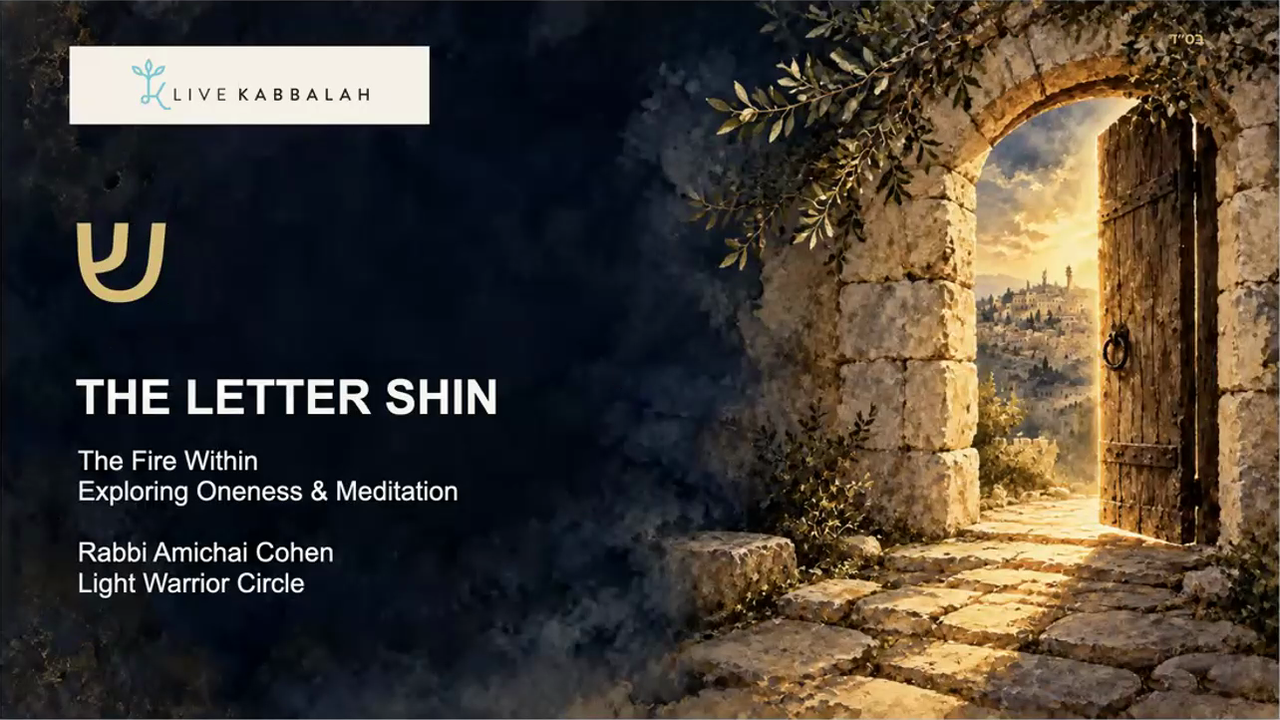
How do we keep the fire burning once the holidays are behind us? Tishrei gave us so much light. Now the winter months begin, and ordinary life asks whether that light can stay with us in a conversation, a decision, or a long day of work. The letter Shin speaks to this question directly, because Shin is the letter of fire.
In Sefer Yetzirah, Shin is one of the three mother letters. Aleph is air, Mem is water, and Shin is fire. The letter itself carries three branches, Avraham, Yitzchak and Yaakov, which are Chesed, Gevurah and Tiferet. With the dot on the right it is Shin, the side of loving kindness. With the dot on the left it is Sin, the side of judgment. A very fine difference in sound holds a whole inner teaching.
Anyone who has tended a good fire knows that it is an art. Put on too many logs at once and the fire burns out. Put on too few and it fades. The middle branch of the Shin, Yaakov and Tiferet, is that balance between giving too much and holding back too much. This is the kind of fire we want: warm, steady, and able to last.
King Solomon calls the soul the candle of G-d. A flame always reaches upward, as if it wants to return to its source, and the soul has that same longing. So the first question of the Shin is a personal one. Where do I feel a living desire to come closer to Hashem? What gives that desire expression in my ordinary day? For one person it is prayer, for another it is learning, giving, movement, or time outdoors.
Sefer Yetzirah also describes the flame bound to the coal. The flame rises, but it does not produce its own light. It draws from the coal. This is a great comfort. We do not have to go looking for strength somewhere outside of us. The source is already there, at the level Chassidus calls atzmus, the essence. Our work is to remember to draw from it. The Lubavitcher Rebbe taught that our generation in particular has the power to live from that essence, and this is the consciousness of Geulah: recognizing that there is one unity in everything, including our bodies and the physical world.
Shin is also the letter of shinui, change. The prophet Malachi says, "I am G-d, I have not changed." Hashem is constant, so we are the ones who change in order to meet Him. Shin has the value of 300, the full spelling of the name Elohim, the name of G-d hidden within nature. Sometimes change begins with a strike, the way the first fire came from two stones striking each other. It does not have to stay harsh. We can build routines of light that keep us replenished, so that we are not left asking where our fire went. What is ready to change in my life, and which commitment will guide that change?
Look closely at the word simcha, joy. It is written with a Sin, the letter on the side of Gevurah. Joy is not always our default. Sometimes we have to ignite it. Rabbi Nachman teaches that we should do what we need to do to make ourselves joyful, even something silly. Put on music, get up and dance, smile at someone before you feel like smiling. The fire follows the action.
Shin is also shen, a tooth. A tooth breaks food down so the body can receive it, and a teaching also needs to be chewed before it becomes part of how we live. In a world of endless scrolling there is little time to chew on anything. The Shema asks that the words of Torah be sharp and clear in our mouths, so that we know what we believe in and can answer with confidence. Which teaching do I want to chew on this week instead of rushing past it?
The Shin can also guard the fire. Our sages teach that silence, shtikah, protects wisdom. The Zohar connects the kindling of fire on Shabbat with anger, a fire that burns in the wrong direction. When someone baits us and we choose to stay quiet, we keep our inner fire from being pulled into an argument where everyone gets hurt. And the word Shechinah, the Divine Presence, is itself written with a Shin. It comes from shachen, a neighbor. G-d wants to be close to us, as close as the one who lives next door.
So this week, choose one thing that stokes your fire. It does not have to be large. It may even be something you stop doing, like a little less time on a screen. Let the flame stay connected to its coal.
You can also listen to the teaching on Spotify:
Members can watch the full class here, including the questions and answers, the source sheet and the slides.
Many blessings, Rabbi Amichai