The Four Beasts of Daniel, The Rise and Fall of Empires, and Our Times
Dec 02, 2025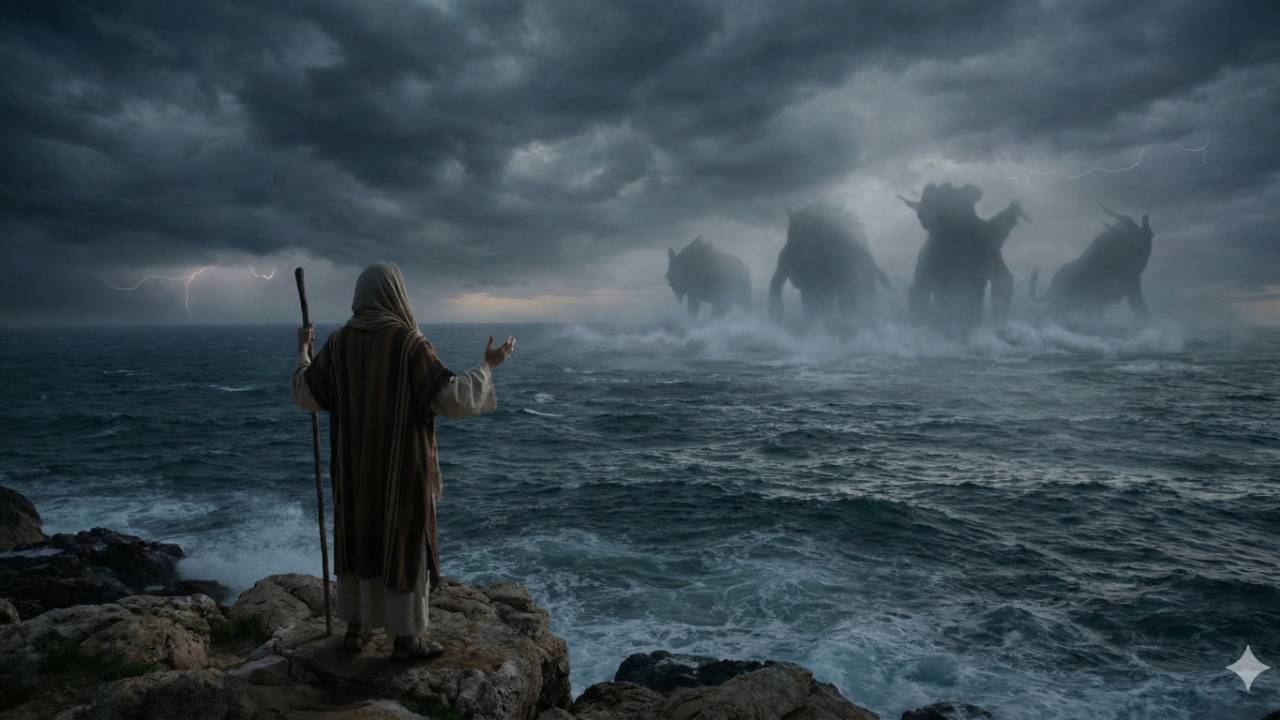
I do not know how many of us have actually learned Sefer Daniel in depth. It is one of the most mysterious and least studied books in Tanakh. Of the 24 books, Daniel is unique: much of it is written in Aramaic, and its language is visionary, symbolic, sometimes almost like a prophetic “science fiction”.
Daniel himself was one of the brilliant young minds taken in the first Babylonian exile, the “Galut Charash u’Masger”. The Babylonians did not only destroy the Temple; they exiled the greatest spiritual and intellectual leaders of Am Yisrael – among them Daniel, Yechezkel, and according to some opinions even Mordechai.
Daniel grows up in the royal court of Babylon together with his three friends, Chanania, Mishael, and Azaria. These four tzaddikim become close advisors to the king and live through the great upheavals of their time.
The early chapters of the book focus on well-known stories:
-
Daniel thrown into the lions’ den,
-
Daniel interpreting Nebuchadnezzar’s dream when no one else is able to, through Ruach HaKodesh.
But in chapter 7, which we learned together in this class, Daniel suddenly shifts from interpreting other people’s dreams to having his own overwhelming vision of the future. This chapter is one of the deepest sources we have about the end of days, the four empires, and the coming of Mashiach.
And it is very relevant to the days we are living in right now.
Kislev, Dreams, and Daniel’s Vision
We are in the month of Kislev, which Sefer Yetzirah associates with the power of dreams. The parshiot of this time are full of dreamers: Yaakov, Yosef, Pharaoh. These are not random night images; they are symbolic maps of history and soul.
We often learn about Yaakov’s ladder, Yosef’s dreams, and Pharaoh’s dreams. There are entire libraries of commentary just on Yaakov’s ladder. But many of us have never really explored the dream of Daniel in chapter 7, even though it is one of the major prophetic visions of Jewish history.
In this chapter, Daniel sees four strange beasts rising from a stormy sea. Through the classic commentaries – Rashi, Ibn Ezra, Rabbeinu Saadia Gaon, the Malbim and others – we understand that these four beasts represent the four great empires under which Am Yisrael would be exiled.
The Four Beasts and the Four Exiles
Daniel describes:
“The four winds of heaven were stirring up the great sea, and four mighty beasts, different from each other, emerged from the sea.”
The sea represents the hidden, turbulent world of history. The four beasts are the four empires – Babylon, Persia–Media, Greece, and Rome – each with its own personality and spiritual “DNA”.
1. The Lion with Eagle’s Wings – Babylon
The first beast is:
“Like a lion, with eagle’s wings… its wings were plucked, it was lifted from the earth, and it stood on two feet like a man, and a human heart was given to it.”
The commentaries explain that this is Babylon, ruled by Nebuchadnezzar, who is compared to a lion. The destruction of the first Beit HaMikdash happened in the month of Av, associated with the sign of Leo – the lion. The “lion” (Babylon) destroys the House of the Lion (the Temple, associated with Yehudah), in the month of the lion.
The eagle’s wings represent the speed, power, and sophistication of Babylon. Over time, those “wings” are “plucked” – the empire weakens, loses its confidence and stability, and begins to fall. The “heart of man” here is not necessarily a compliment; it can imply a softening, a loss of the fierce, unshakable power that once defined the empire.
2. The Bear with Three Fangs – Persia–Media
The second beast is:
“Like a bear, raised on one side, with three fangs in its mouth. It was told: ‘Arise, eat much flesh.’”
Chazal describe Persia as coarse and “hairy” like a bear – powerful, heavy, sometimes brutal. The three fangs represent the three main Persian–Median kings who shaped the destiny of Am Yisrael:
-
Cyrus – who allowed the Jews to return and begin rebuilding the Temple,
-
Achashverosh – whose reign is the backdrop of the Purim story,
-
Darius – who ultimately allowed the building of the Second Temple to be completed.
The “much flesh” is the enormous wealth and resources of the Persian Empire – a kind of economic superpower of its time.
3. The Leopard with Four Wings and Four Heads – Greece
The third beast is:
“Like a leopard, with four wings on its back like a bird, and the beast had four heads, and dominion was given to it.”
The leopard (in Hebrew, namer) has many spots. The commentaries explain that this points to the many decrees the Greeks placed on Jewish life – banning Shabbat, Rosh Chodesh, Brit Milah, Torah learning, and more. Each “spot” is like another decree.
The four wings and four heads refer to what happened after Alexander the Great died. His vast empire did not stay unified. It split into four main kingdoms, centered in regions like:
-
the areas of today’s Greece / Balkans,
-
Egypt (Alexander and later the Ptolemies in Alexandria),
-
Eretz Yisrael (where much of the Chanukah story takes place),
-
and regions associated with Turkey / Syria.
Rabbeinu Saadia Gaon and other commentaries map these heads and wings to specific historical centers of Greek power.
4. The Terrifying Beast of Iron – Rome and Beyond
Then comes the fourth beast:
“A fourth beast, terrifying and dreadful and very powerful, with great iron teeth; it devoured and crushed, and what was left it trampled with its feet… and it had ten horns.”
This beast is not compared to any known animal. It is something beyond. The classic understanding is that this is Edom / Rome, the longest, most spiritually complex exile, which in many ways we are still inside.
The ten horns, explain Rashi and others, represent ten primary emperors / centers of imperial power. The beast’s iron teeth and trampling feet symbolize total destruction – Rome’s ability to crush anything in its path, physically and culturally.
Then the vision intensifies:
“I was looking at the horns, and behold, another little horn came up among them… there were eyes like human eyes in that horn, and a mouth speaking arrogant words.”
Chazal and the Rishonim struggle with this “little horn” that appears at the end of the Roman phase. Many, including Rabbeinu Saadia Gaon, understand it as alluding to a later power that grows out of that Roman world and fights over spiritual and political dominion.
In Rabbeinu Saadia Gaon’s reading, the final phase of exile is associated with the children of Ishmael. Historically, we have seen intense conflict between Christian empires and Islamic empires – battles over Eretz Yisrael, over Europe, over spiritual influence. Across generations, these struggles have taken different forms – crusades, imperial wars, ideological clashes – but the root remains a deep wrestling over whose vision of God and morality will shape the world.
It is very important to say this carefully and with humility:
Chazal and the Rishonim are not speaking about individual Muslims as people, many of whom are sincere, good, and ethical human beings. They are describing spiritual forces and imperial ideologies – how power, religion, and empire combine at the end of days, and how that intersects with the destiny of Am Yisrael.
“Thrones Were Set” – The Ancient of Days
At this point, Daniel suddenly sees a completely different scene:
“Thrones were set in place, and the Ancient of Days sat. His garment was white as snow, the hair of His head like pure wool. His throne was fiery flames… A river of fire flowed and came out from before Him. Thousands upon thousands served Him… The court sat, and the books were opened.”
The Zohar asks: how can we describe God in such human terms – white hair, garments, a throne? We know that God has no body and no form. The answer given in Kabbalah is that this is not describing God’s essence, but a very high spiritual level called Atik Yomin – “the Ancient of Days”, linked with Keter, the superconscious Divine will that is beyond worlds.
From that level of Keter there are two aspects:
-
Arich Anpin – the long, patient Divine “face” that channels the sefirot into creation,
-
Atik Yomin – God beyond any measure, beyond any definition.
When Daniel sees God as an “elder” in white, it is an image of Divine compassion and judgment with mercy. The white garments and white hair symbolize an immense, cleansing compassion, a readiness to “whiten” and wash away the accumulated filth of history.
Rabbeinu Saadia Gaon explains that the “thrones” being removed refer to all the thrones of earthly kings and the spiritual forces behind them. All the empires that imagine they will last forever are suddenly shown to be temporary. Their thrones are cast down.
The only true and lasting sovereignty is Malchut Hashem, the Kingship of God.
The “books” being opened parallel what we know from Rosh HaShanah and Yom HaDin:
-
there are books of the righteous,
-
books of the wicked,
-
and also a book of the nations, a spiritual accounting of how each people behaved, especially in relation to Am Yisrael and to basic morality.
Reading Daniel in the Light of Our Times
When we look at Daniel’s vision and then look honestly at the world today, it is hard not to feel how deeply we are inside this chapter.
We see:
-
The long echo of Rome / Edom in Western culture, politics, and values.
-
The growing strength and influence of nations descended from Ishmael in global economics, energy, media, and international institutions.
-
The way alliances shift as countries depend on oil, money, and strategic interests.
-
The rise of loud, sometimes aggressive ideological voices – some religious, some secular – that are often openly hostile to Israel and to the covenantal vision of the Torah.
We also see a rise in anti-Semitism, double standards against Israel, and the feeling that many of the systems we relied upon for stability and fairness are no longer so stable or fair. Resolutions in world bodies pile up against Israel, while regimes that commit atrocities barely receive criticism.
The Gemara says that at the end of exile, “Ein lanu al mi lehisha’en ela al Avinu she’baShamayim” – we have no one to lean on except our Father in Heaven. Daniel’s dream brings that home in a very sharp way.
And yet, the purpose of this vision is not to leave us in fear. It is to anchor us in emunah.
Christianity, Islam, and the Preparation for Mashiach
The Rambam writes that both Christianity and Islam, despite their distortions and serious theological problems, play a role in preparing the world for the coming of Mashiach. Through them, the basic ideas of:
-
One God,
-
Torah,
-
Mitzvot,
-
Mashiach,
-
reward and punishment,
spread to vast parts of humanity. In that sense, they “globalize” certain concepts that originate in Tanakh, so that when the truth becomes fully revealed, the world already has a language for it.
From a halachic perspective, the Rambam rules that Islam is a form of pure monotheism (even though it has many other issues), which is why a Jew may technically pray in a mosque. Christianity, on the other hand, is rooted in beliefs that enter the territory of avodah zarah for a Jew. So there is a paradox: Islam is purer in its concept of One God, but historically some Islamic empires have expressed that through coercion and violence. Christianity introduced other distortions, but also at times created space for ethics, law, and culture that benefitted the world.
Daniel’s vision hints that as history moves toward its conclusion, these religious and cultural forces will all have to confront the truth of the One God, the people of Israel, and the Torah. The Rambam says that in the days of Mashiach, “they will all return to the true religion” – meaning a purified recognition of God’s unity.
The Dreidel, Hanukkah, and Who Is Spinning History
As we approach Chanukah, there is another beautiful layer. The four sides of the dreidel represent the four empires:
Nun – Nefuchadnetzar / Babylon,
Gimel – Greece (Yavan),
Hei – perhaps Haman / Persia,
Shin / Pei – Shem or Se’ir / Rome, depending on the minhag and lettering.
All four empires “spin” us around, exile after exile. But what is on top of the dreidel? The invisible Hand that spins it. Hashem is the One turning history, even when it looks chaotic.
We say “Nes Gadol Haya Poh / Sham” – a great miracle happened here / there. Great miracles are indeed happening, sometimes openly, sometimes hidden. Protection of communities on the border, breakthroughs in technology, salvations that by nature should not have occurred – these are all hints that Hashem is deeply engaged with us in this story.
From Fear to Emunah
When Daniel finishes hearing the interpretation from the angel, he says:
“My spirit was disturbed within me, and the visions of my mind alarmed me… my face darkened, and I could not put the matter out of my mind.”
It is heavy. It is not simple to witness thousands of years of history compressed into one night vision.
But we must not stop in the heaviness. The core promise of the chapter is this:
“The holy ones of the Most High will receive the kingdom and will possess the kingdom forever, forever and ever… His dominion is an everlasting dominion that shall not pass away.”
At the end of all the beasts, horns, empires, and ideologies, there is a human figure coming with the clouds of heaven, presented before the Ancient of Days. Chazal understand this as Melech HaMashiach. The clouds represent humility, gentleness, and a redemption that does not need more war horses and iron weapons, but arrives with Divine grace.
This is not a “maybe.” From a Torah perspective, it is a certainty. Mashiach will come. Malchut Hashem will be revealed in the world. The only question is how we choose to stand, to act, to refine ourselves and our communities during the birth contractions of that new world.