Returning to the Tree of Life: Giving, Receiving, and the Fixing of the I
Jul 13, 2026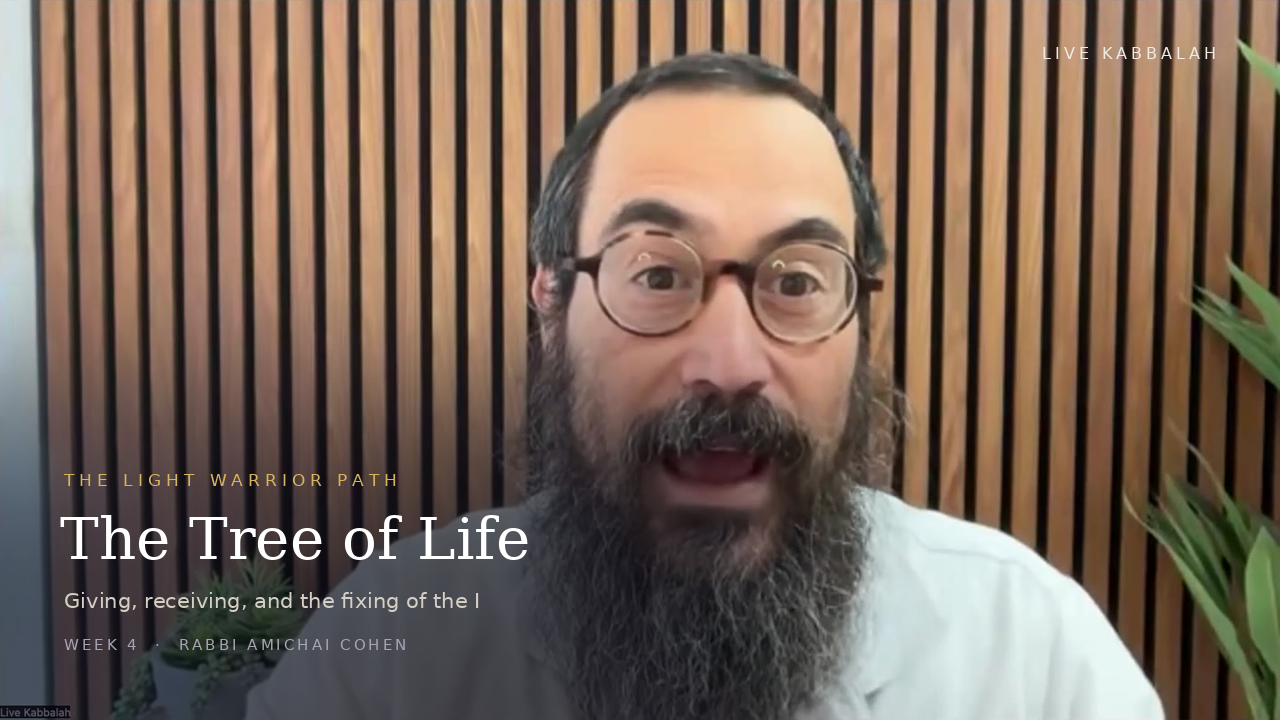
There is the I, and then there is the I.
One of them is a portion of the Creator. The other one is the animal self. They both use the same word, and most of the confusion of a life comes from not knowing which one is speaking.
This is where the class began, from a question in the room, and it opened straight into the Tree of Life.
Watch the Teaching
What we actually lost
Before the sin, Adam and Eve lived in constant connection to the Source. They were co-creators. There was no ego standing in the way of the flow. That is what the Tree of Life is. The sap rises, the fruit comes, and there is no gap between the inner world and the outer world. It says that in the days of redemption it will be like this again, so completely that a seed planted will almost immediately give its result.
After the sin, there is duality. There is me, and there is something outside of me. There is good, and there is now the possibility of bad, and the possibility of bad originates within me.
Christianity reads that story as proof that man is evil from birth. We do not read it that way. We read it as a cosmic setup. G-d arranged the fall into duality on purpose, so that there would be something real to fix.
Three words, one set of letters
Take the Hebrew letters of tikkun, fixing, and rearrange them. You get tinok, a baby. Rearrange them again and you get nituk, disconnection. The same letters hold the whole arc of a life.
Tinok. A baby takes, and it must take. Feed me. Change me. Everything is for me. That is not a flaw in the baby, it is the design. But tinok is a consciousness, not an age. An adult can carry it for a lifetime: the friendship that exists to serve me, the relationship where the other person is there to meet my needs. At one extreme it becomes narcissism. At the other extreme it becomes a person who allows themselves to be overtaken, because being treated that way is the only thing they have ever known, and it registers as safety.
Tikkun. This is most of a life. It is the refinement of giving and receiving, and there are four levels. Selfless giving at the top. Selfish receiving at the bottom. And in between, receiving in order to give, and giving in order to receive.
Once you see the four levels, the question changes. It is no longer whether giving is good and receiving is bad. The question becomes why. Why am I giving? Why am I receiving? A person who gives compulsively may discover that their fixing is to receive. A person who only takes may discover that their fixing is to give. Giving can be smothering. Giving can be a way of getting something back. The refinement is the work.
Nituk. Disconnection. Not from life, and not from what we must do each day. Disconnection from the charade. From the rat race. From needing the result. It is being present to what is, and letting G-d work through us. The sages used to bless one another that they should taste the next world in this one.
What do you bow down to?
Rabbi Shimon bar Yochai writes in the Zohar that he does not bow down to any human being, only to the Creator.
The Aramaic word for bowing is chivya, and chivya is also the word for the snake. It shares a root with Chava. The snake did not put the question into her. The snake showed up because the question was already there. What appears outside of us is sparked by what is already inside of us.
So the question becomes very ordinary and very sharp. What am I actually bowing to? The star. The influencer. The team. The money. The nine to five. The mortgage. None of those things need to disappear. Enjoy the match. But am I enjoying it, or am I worshipping it? Am I here, or am I already fifteen minutes from now?
The two cherubs
The biblical day begins at night. Light does not arrive in this world without darkness first.
We are born to survive. The wounds we take as children are wounds we had no capacity to process at the time, and that child is still waiting. In the temple there were two cherubs facing each other, one large and one small. That is the inner temple. The adult self looking at the child self and saying: you are safe. You were always loved. G-d was always here.
And when someone asks how far back they must dig to find the root of it, the answer is gentler than the mind wants to hear. Over questioning is its own excess. Whatever emotion is rising now is the only thing being asked of you. The mind wants to be the fixer, to go hunting through past lives and old stories. The child only wants to be heard. Put a hand on your heart and listen. That is already awareness, and awareness is already the separation.
Listen to This Teaching
For your reflection
- Which is your default, giving or receiving? And when you look underneath it, why do you do it?
- What are you bowing down to right now, without calling it that?
- What is the emotion that keeps rising in you lately, the one your mind keeps explaining instead of listening to?
This teaching is from Week 4 of the Light Warrior Path, the nine week initiation into Kabbalah and Chassidut. To learn more, visit livekabbalah.com.