The Letter Tzaddik: Staying Connected Through the Seasons
Sep 23, 2026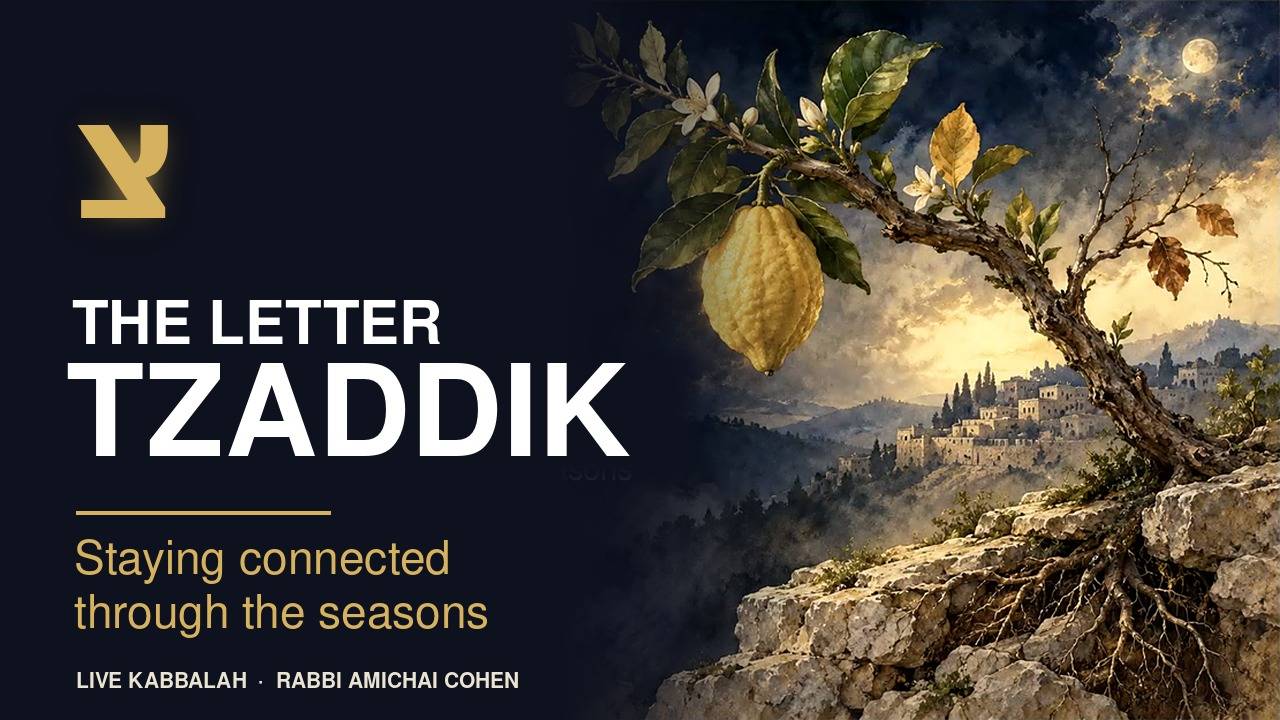
Based on our Light Warrior Circle class, The Mystery of the Hebrew Letters, with Rabbi Amichai Cohen.
Yom Kippur is behind us. We were lifted, we were forgiven, we stood for a whole day as close to G-d as we know how to stand. And now comes the real question, the one that follows us into the whole year. What does it mean to remain connected when the season changes?
The letter Tzaddik, צ, holds the answer, and the etrog shows it to us. Look at the shape of the letter. It stands upright, rooted, with its arms reaching up like the branches of a tree. It does not sway. The Zohar teaches that every letter holds worlds in its shape. It is no coincidence that the Hebrew word for tree, etz, ends with a final Tzaddik.
On Sukkot we take the four species. The etrog has both taste and fragrance, Torah and good deeds together, and so it is the one associated with the tzaddik. But the Talmud gives the etrog another name. The Torah calls it pri etz hadar, and in Sukkah 35a Rabbi Abbahu reads hadar as ha dar, the one that dwells. הדר באילנו משנה לשנה. The etrog dwells on its tree from year to year. Other fruit ripens in its season and then it is picked, or it falls, or it rots. The etrog stays attached through fall, winter, spring, and summer. It weathers every season without letting go.
Every season has its own gift and its own challenge. Grapes need the summer sun, and too much of it finishes them. Citrus shines in the winter, just when we need it most. Each fruit has its moment. The etrog is different because every season becomes part of its growth.
One of my children asked me today which season I like best. Miriam had just said that she loves the crispness of the cold, and my daughter turned to me and asked, but do you not like the summer? I told her that I like the summer, and I like the fall, and I like the winter, and I like the spring. I like the season that is. So often we say, this is not my season, and we want to drop off the tree until something better comes. The truth is we cannot do that. The season we are in is the one we are meant to find value in. The work is to stay on the tree.
Which tree? The Tree of Life. Most of the year we live in the Tree of Knowledge of good and bad, in duality and all of its challenges. On Rosh Hashanah and Yom Kippur we were given a bird's eye view of our lives. Now we step back down into the seasons, and the etrog tells us that we can pass through all of them and still remain attached.
The Talmud in Rosh Hashanah 16b teaches that three books are opened on Rosh Hashanah. One for the tzaddikim, one for the beinonim, and one for the reshaim. Most of us live in the middle. Some days we are free, some days we are imprisoned by the ego and the yetzer hara, and sometimes it changes within a single morning. The Alter Rebbe wrote the Tanya as the Sefer shel Beinonim so that we could understand this inner scale. We are written, we are sealed, and there is a tradition that the decree is only delivered on Hoshana Rabbah. So the question of these days is simple. After the inscription, how do we live?
Right in the middle of these days, we go out and buy an etrog. We pay for it with our own money, and we hold in our hands a living image of who we want to be all year long. That is what a tzaddik is. King Solomon calls the tzaddik yesod olam, the foundation of the world, and Isaiah says of our people, v'amech kulam tzaddikim, your nation are all righteous. Every one of us carries this level inside, even when it is covered and we do not feel it. A tzaddik is the one who holds on. A storm comes, the heat is too much, spring tempts me to chase every flower, fall blows its leaves all over me, and I stay with my soul. People outside may tell me I am crazy. I stay with the inner truth.
Tzaddik has the numerical value of ninety, and a tzaddik knows how to bend. The letter itself comes in two forms. The regular Tzaddik is bent, and the final Tzaddik stretches straight down. The Talmud in Shabbat 104a reads them as tzaddik kafuf and tzaddik pashut, the bent tzaddik and the straight tzaddik. The bent Tzaddik is not having Yom Kippur all year round. It is dealing with taxes and difficult people and whatever else life brings, and it keeps asking one question. Will this disconnect me?
To tell you the truth, I struggle with this. I have a strong truth-seeking side, and when people are problematic I tend to go head to head with them. What I have learned is that this usually just entangles me further with someone who is not going to change. Sometimes the wiser path is to get the job done, pay the person, and move on. Sometimes you have to be smart rather than right. My grandfather taught us this without ever speaking about it. He was so humble and so diplomatic that he could reach people who were fighting with each other, and he never took it personally. He let it brush past him.
Pirkei Avot 5:21 says, ben tishim lashuach, at ninety, to bend. The Mishnah is describing the posture of old age, and it is also a teaching for the letter. Maturity can bow without collapsing. We do not always need to be the one who is right. If we fight every battle, we will not have the strength to stay on the tree. Choosing our battles is not weakness. It is humility, and humility is what keeps us connected.
The straight Tzaddik reaches all the way down. This is Yosef HaTzaddik, the foundation of the world, and Sha'arei Orah explains that Yesod is the letter Tzaddik, the ninth sefirah counting from Keter. A tzaddik on that level carries blessing all the way down into the world. People who walked past the Rebbe for dollars describe a light so present that they did not know what to say. Of such a person it is said, tzaddik gozer v'Hakadosh Baruch Hu mekayem, the tzaddik decrees and G-d fulfills. Most of us are not on that level. We are still a tzaddik inside, on our level, and we are learning how to bend.
From tzedek we come to tzedakah. The Zohar teaches that when the letter Hei is added to righteousness, it becomes giving. Kabbalistically, the tzaddik is Yesod and tzedek is Malchut, and when we actually give something tangible, the two are joined and a oneness opens inside the world itself. Every mitzvah does this, and the word mitzvah carries a Tzaddik inside it too. So the question of this letter becomes very practical. What becomes visible in our actions?
The etrog remains attached, and its fruit keeps growing. So what practice will keep you connected when the inspiration feels far away? It will feel far away. That is the nature of seasons. The first answer is learning, every day. When we do not learn, we forget. We say, that was a beautiful class, and then it is gone. Yom Kippur is the day we received the second tablets, the ability to learn and stay connected. Action alone, when it is dry, will not hold a person. When learning from the right source and with the right intention illuminates our deeds, the action itself comes alive. Then you can add meditation, mikvah, writing, volunteering, and anything else that serves you.
The letter also has a shadow, and a way through it. Tzar, tzur, tzohar. Constricted, steady, illuminated. Tzar is the narrow place, and we all know it. Tzur is the rock. We call G-d Tzuri v'Go'ali, my Rock and my Redeemer, and when the Thirteen Attributes of Mercy were revealed, Moshe was hidden in nikrat hatzur, the cleft of the rock. The tzur is the essence inside us, and a rock can ignite. The Talmud in Pesachim 54a teaches that after the first Shabbat, when Adam felt the darkness for the first time, he took two stones, struck them together, and fire came out. That is the root of our Havdalah candle. Even when I feel far from the tree, I can strike the rock inside me and bring light into my week.
And then tzohar. Noah was told, tzohar ta'aseh lateivah, make a window for the ark. The Baal Shem Tov teaches that teivah also means a word. Let the spoken word shine. When we learn and when we pray, we do not want empty words. We want each word to open a window. This is very practical. Keep a go-to Psalm, something short, like Psalm 23, or 20, or 100. When you find yourself in a narrow place, say it slowly and let it become a window. Which word, prayer, or act can bring a little light into your narrow place?
Psalm 92 says, tzaddik katamar yifrach, the righteous one flourishes like a palm tree. The palm is the Psalm's tzaddik, and the etrog teaches staying attached. Two images for carrying the new year into ordinary life. A palm grows its branches and then keeps growing past them, higher and higher. We go through phases too. We finish something and think, that was my season, I am done. But a tzaddik keeps going to the next level. There is no retirement from what you are called to do. And King Solomon says, sheva yipol tzaddik v'kam, a righteous one falls seven times and rises. The tzaddik is not the person who never falls. It is the person who gets back up and keeps growing.
So when you sit in the sukkah this year, surrounded by G-d's embrace, take a few quiet minutes with two questions. Where will I stay connected this year? And what can flow through me to someone else? Maybe it is Tehillim in the morning, davening with more intention, a little more learning, one more mitzvah. And give tzedakah every day, even a few coins in the pushka before you pray or before lighting Shabbat candles. Giving opens the channel to receive. That is how the etrog stays on its tree, and that is how we do too.
This teaching is from EOM #114 of our weekly Exploring Oneness class. Light Warrior Circle members can watch the full class here. To go deeper into the Hebrew letters and the path of the Light Warrior, explore The Light Warrior Path Course.
Chag Sameach, and may you stay connected through every season of this year.
Many blessings,
Rabbi Amichai