The 70th Soul: How Hashem Sends Hidden Help
Dec 29, 2025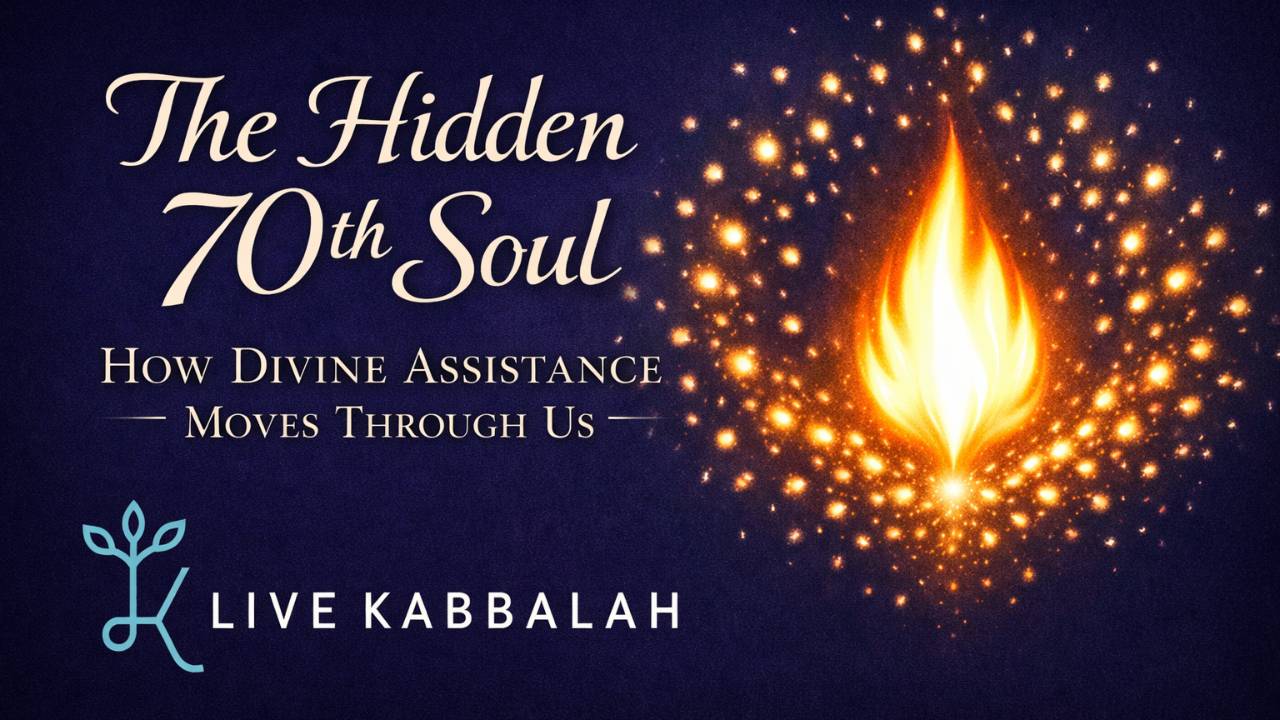
A synopsis of a live class given by Rabbi Amichai Cohen, from our Light Warrior program, 12/28/2025:
Over the last few weeks, we have been circling around a mysterious Kabbalistic idea: ibur—an “impregnated soul,” a soul-assistance that can come into a person’s life to strengthen them, guide them, and help them complete something they could not complete alone.
It sounds lofty, even abstract. But the Torah gives us an entry point that is surprisingly concrete.
The riddle of the 70 souls
At the beginning of the exile in Egypt, the Torah tells us that seventy souls came down with Yaakov’s family. Yet when you sit down and count the names, something does not add up.
Rashi famously does the math for us: the list totals sixty-nine.
So why does the Torah insist: seventy?
And here the commentators open a doorway. Not only to solve a numerical puzzle, but to reveal something about how exile works—and how redemption begins.
Yocheved: the soul “between the walls.”
Rashi brings one of the best-known answers: Yocheved, the mother of Moshe, was born “between the walls,” meaning in the transition space—no longer fully in the Land of Israel, not yet fully in Egypt.
She becomes the 70th soul.
And this is not just trivia. Yocheved is the mother of redemption—she gives birth to the redeemer. She represents a spiritual archetype: someone who can enter the exile, but not become swallowed by it. Close enough to uplift those inside, yet anchored enough not to be absorbed.
A bridge-soul.
Serach bat Asher: the soul that outlives exile
Another opinion points to a very different woman: Serach bat Asher.
There is an old tradition that even mentioning her name is a segulah—especially on Saturday night. Why? Because Serach is associated with continuity, memory, and endurance. Some traditions teach she lived for centuries, spanning generations, carrying the inner thread of Israel through the darkness.
If Yocheved is “between the walls,” Serach is “beyond time.”
And some say: she is the 70th.
Or perhaps… the 70th is Yaakov. Or the Shechinah.
Other voices say the missing soul is Yaakov himself—the father-soul who gathers the whole structure into one.
And others go even deeper: the 70th is not a person at all, but Hashem’s Presence—the Shechinah—descending with them into Egypt.
Meaning: exile is never “only exile.” Even there, the Divine descends with you.
But then we come to a stunning explanation—one that opens directly into the world of ibur.
Dan’s “extra soul” and the mystery of Chushim
The Maharal of Prague brings a tradition (quoted in later sources as well) that reframes the entire count of seventy.
Look at the tribes:
-
Binyamin has ten sons.
-
Dan has one son: Chushim.
Yet later, when Israel is counted in the wilderness, something feels upside-down:
Dan becomes one of the largest tribes.
Binyamin becomes one of the smallest.
How could that be?
And here the Maharal introduces the idea that Chushim was not only one soul.
He carried something extra.
An additional spiritual measure. An added “soul-level.”
When the Torah counts “seventy,” it is counting not only bodies, but hidden spiritual accompaniment. It is counting a reality that is not visible to the eye.
Dan brought down an extra soul.
And that “extra” is part of what completes the seventy.
This is already the language of ibur: a soul that joins another soul, not as reincarnation, but as assistance—an additional spiritual engine inside a person.
Why Chushim matters: the Midrash of Esav’s head
Now Chushim has another strange feature: the Midrash says he was deaf.
And it is precisely this “limited” person who becomes the unexpected hero at one of the most charged moments in the Torah.
When Yaakov is brought for burial in the Cave of Machpelah, Esav arrives and protests:
“This is my place.”
A confrontation breaks out. The funeral is stalled.
And Chushim—deaf, not caught in the arguments, not pulled into the drama—sees one thing only:
“My grandfather is being dishonored.”
So he takes a weapon and strikes Esav, and the Midrash describes Esav’s head rolling into the cave near Yaakov—while Yaakov, in a mysterious moment, opens his eyes and smiles.
The deeper point is not violence. The deeper point is this:
Sometimes the one who saves the entire story is the person you would least expect.
Sometimes what looks like a disadvantage becomes the exact instrument of redemption.
Chushim could not “hear” the confusion. He could not be manipulated by noise. He acted with simple truth.
And this is the message: you cannot judge a soul’s purpose by external appearance.
The big teaching: we do not see what is really assisting us
This is where the class turned into something very personal.
So many of us live with a quiet question:
Why is my life this way?
Why am I stuck in this pattern?
Why am I on the same hamster wheel again and again?
And the Torah whispers back:
You are seeing one percent.
Hanistarot LaShem Elokeinu—the hidden belongs to Hashem.
What we see is the surface. But beneath the surface there is an internal mechanism of providence that we do not understand.
The story of the “70th soul” is a coded way of saying:
You are not alone in your work.
You are doing the work. Your choices matter. Your prayer matters. Your mitzvot matter.
But there may be help you do not see.
There may be souls attached to your journey.
There may be a Divine choreography behind what looks to you like randomness.
And this brings us to ibur.
What is ibur?
In the teachings of the Arizal, ibur is not the same as reincarnation (gilgul).
A gilgul is when a soul returns because it has unfinished repair.
An ibur is when a soul (or soul-aspect) that is already repaired temporarily joins a person, to assist them.
It can assist on the level of:
-
Nefesh (action, behavior, concrete life)
-
Ruach (emotion, relationship, inner alignment)
-
Neshamah (mind, consciousness, spiritual clarity)
And it comes for two reasons:
1) To help you get off the hamster wheel
Sometimes a person has been repeating the same struggle for lifetimes. The same fear. The same pattern. The same stuckness.
And then, through prayer, through merit, through Divine compassion, Hashem sends assistance.
Not because you “summoned” anything (we do not do that), but because Hashem sees you are ready for a breakthrough.
The result can feel like a sudden new vigor, a clarity, a strength that is “you”… but also more than you.
2) To help the assisting soul gain something it cannot gain in Heaven
Here is the paradox:
Souls in Gan Eden are basking in Divine light, learning Torah in higher academies, refining endlessly.
And yet—they cannot do mitzvot.
Only here, in a body, in the physical world, can mitzvot be performed.
So when an assisting soul joins you and helps you perform mitzvot, it gains an elevation as well. In that sense, it is not “bothered.” It is participating in something unique that only this world can provide.
A Tanya lens: the “spirit from above.”
The Tanya echoes this idea in its own language: a person can merit a “spirit from above,” a Ruach rooted in a tzadik, that attaches itself to them—so they can serve Hashem with true joy.
Meaning: you are not meant to muscle your way through life alone. Hashem can expand a person from within.
But again: we do not “call souls.” We ask Hashem.
And Hashem has many messengers.
So how do we relate to all of this in a healthy way?
Here is the grounded version:
-
Do not obsess over “Who was I in a past life?”
-
Do not try to map your identity through mystical speculation.
-
Do not attempt to summon spiritual beings.
Instead:
-
Ask Hashem for help.
-
Choose again today.
-
Pray even if you only “want to want.”
-
Keep spiritual hygiene: speech, humility, honesty, cleanliness of heart.
If assistance comes, it comes through Hashem.
If it leaves, it leaves through Hashem.
Your job is simple:
Stay in relationship. Stay choosing. Stay returning.
A closing blessing for the year ahead
We do not know what we are truly accomplishing. We cannot measure our impact by externals. Chushim looked like “one child.” He ended up changing the destiny of a people.
So may we remember:
-
We are part of a cluster of souls.
-
When one grape rises, it uplifts the whole cluster.
-
When we choose טוב, when we pray, when we do one mitzvah, it shakes worlds.
May the year ahead be a year of peace, unity, healing, and deep inner redemption.
And may we merit to see the final redemption—geulah shleimah—speedily, in our days.
Amen and amen.
Find out more and join our Light Warror Program: https://www.livekabbalah.com/Becoming-a-light-warrior