The Snake, the Staff, and the Secret of Transformation
Jan 26, 2026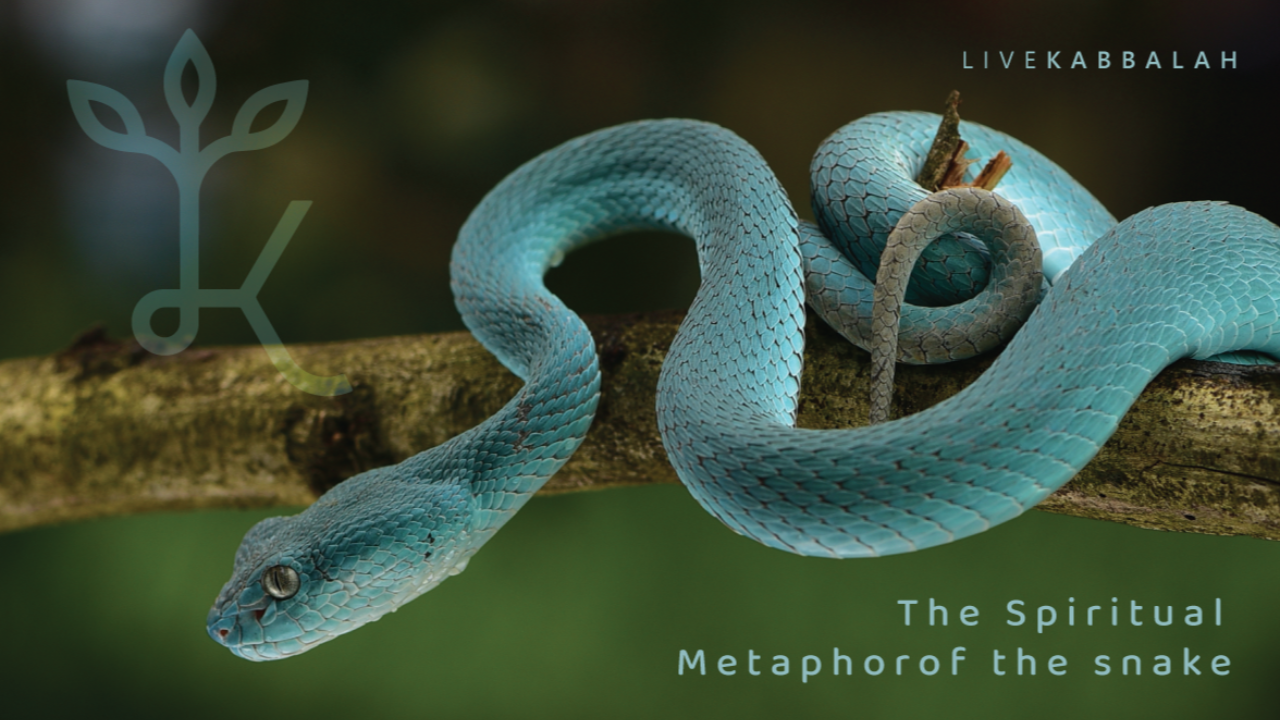
B"H
The Snake, the Staff, and the Secret of Transformation
BY Rabbi Amichai Cohen
The snake is one of the most charged symbols in all of Judaism. It shows up at the beginning of human history, it returns in the drama of the Exodus, and it appears again in the Torah as a force of healing. And because it carries so many meanings, it is easy to reduce it to one simple idea: the snake equals the yetzer hara, the negative impulse.
But the Torah never leaves us with a flat symbol.
In other spiritual cultures, the snake often represents shedding, renewal, and rising energy—what Eastern traditions call Kundalini: the awakening that moves from the lower centers upward, releasing what is old and opening what is higher. Judaism does not speak in that language, but it does speak about something very close: the paradox that darkness can become the very doorway to light.
This week, that paradox became personal for me. I had a dream involving a massive snake—right as I was learning the Zohar’s description of Pharaoh as the “great serpent,” a kind of spiritual boa constrictor that wraps itself around consciousness and constricts the soul. And then I could not ignore it anymore: why does the Torah keep bringing us back to this image?
Because the snake is not only a symbol of downfall. The snake is also a symbol of choice—and therefore, of human evolution.
Pharaoh as the Great Serpent
In Parashat Bo, Hashem says to Moshe: “Bo el Paro”—come to Pharaoh. Our sages ask: why “come,” and not “go”? Because Moshe is being invited into something deeper than a political confrontation. He is being brought into the innermost chamber of exile—into the dark place where the soul feels trapped, frightened, and powerless.
The Zohar calls Pharaoh the “great snake.” Pharaoh is not only a ruler. He is a spiritual force that tightens around a person’s inner freedom.
And then the Torah reveals something startling:
Moshe approaches the snake… with a snake.
The Staff That Becomes a Snake
Moshe and Aharon carry a staff. They throw it down, and it becomes a snake. Pharaoh’s magicians imitate it. But Aharon’s snake consumes the others—and then, Hashem commands something that feels almost impossible:
Grab the snake by the tail.
Not the head. Not the fangs. The tail.
And when they do, it becomes a staff again.
This is not a magic trick. It is a spiritual teaching.
The staff represents directed power—holy authority, purpose, alignment.
The snake represents distorted power—fear, manipulation, ego, reactive desire.
The Torah is showing us that the same life-force can appear in two forms:
- as a staff: channeled, upright, connected
- as a snake: twisted, survival-driven, reactive
And most importantly: the snake has no independent existence. It lives off the same divine energy as everything else. When you hold it correctly—when you face it instead of fleeing it—its energy can be brought back to its root.
The Snake as the Pattern of Human Growth
In Gan Eden, the snake introduces the first great rupture: separation, shame, and exile from innocence. But there is another layer that is often missed:
Before the fall, the snake is described by our mystical sources as a servant of the Creator. Meaning, even the “other side” serves a role in the unfolding of the soul.
Without the snake, Adam and Chava would have remained in a perfect world—but a perfect world without earned consciousness. They would have lived in truth as a given, not truth as a choice.
The snake creates the possibility of failing, and therefore the possibility of returning.
And that return—when it is real—creates a deeper unity than the innocence that existed before.
Healing: The Copper Snake
Later in the Torah, when the people speak negatively—when their words become venomous—the punishment comes through snakes. And then Hashem commands Moshe to create a copper serpent and raise it on a pole:
Whoever looks at it is healed.
This is one of the Torah’s deepest principles: healing does not come by pretending the darkness is not there. Healing comes by facing it, lifting it, and transforming it.
It is the same idea we see in the body. The immune system strengthens through challenge. A vaccine uses a trace of the problem to awaken the power of healing. Even homeostasis depends on tension and recalibration.
The snake is the paradox: the wound becomes the doorway.
Nakhash and Mashiach: The Same Number
Here is one of the wildest revelations:
The gematria of נחש (nakhash)—snake—is 358.
The gematria of משיח (Mashiach)—Messiah—is also 358.
How can that be?
Because Mashiach is not only a person. Mashiach is a revelation: the unveiling that everything—every detail of existence—is vibrating with divine unity. When that truth fills the world, darkness loses its illusion of independence.
So the snake and Mashiach share the same number because the snake is the energy of concealment… and Mashiach is the transformation of concealment into revelation.
On a personal level, this is the inner work: the place you fell is often the exact place where your deepest redemption is hidden.
Two Paths: Moshe and Aharon
There is also a subtle difference in the Torah’s language. Sometimes the staff-snake is called nakhash, and sometimes it is called tannin—a more intense form of serpent imagery.
Mystical commentators explain this as a difference between Moshe and Aharon.
Moshe represents inward truth: clarity from above.
Aharon represents outward speech: communicating through the noise of humanity.
Aharon has to penetrate the thick layers of the human condition—conflict, emotion, ego, misunderstanding. That takes a different kind of strength. Not only intelligence of the mind, but intelligence of the heart.
And that is why Aharon, the man of peace, is connected to the more intense snake imagery. Because transforming people is not sentimental. It is skilled. It is courageous. It is emotionally wise.
The Heart as the Center of the Work
At the core of all this is one central teaching:
Transformation is not only intellectual. It is emotional.
We can “control ourselves” and still remain unchanged. We can suppress desire, suppress anger, suppress pain—and then watch it leak out somewhere else. That is why the Zohar distinguishes between subduing and transforming. Subduing is real, but it is not the final stage. The goal is deeper: to turn the snake back into a staff.
And the place where that happens is the heart.
Aharon wore the Choshen—the breastplate—over his heart. Hidden inside that symbol is a message: the tribes, the names, the stones, the colors—human complexity—can be held in love without collapsing into chaos.
This is Lev Tov. A good heart. The ability to see beyond behavior into the soul beneath it.
The Invitation This Week
The snake is the symbol of the human paradox:
- the force that pulls you down
- and the force that, when lifted correctly, becomes your redemption
May we learn to recognize the snake within without fear.
May we hold it by the tail—at the root.
May we reclaim our power of choice.
And may we transform what was once venom into healing, and what was once exile into light.
Shavua tov, and may we see good omens and good news.
From a class on our Light Warrior program: